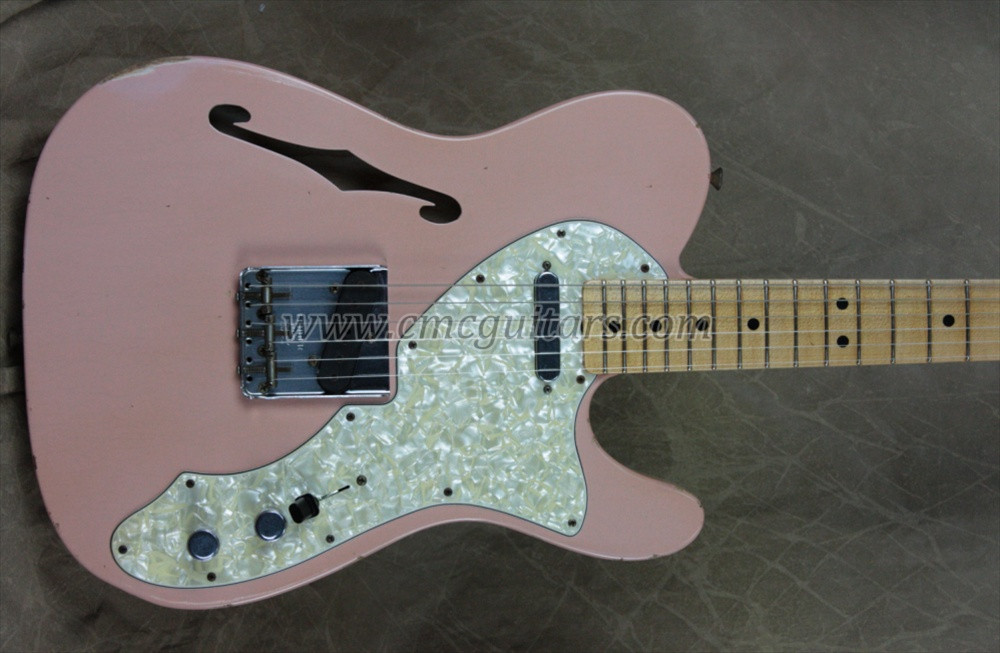
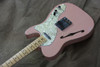
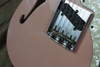
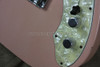
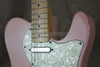
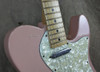
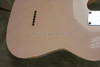
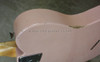
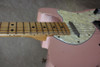
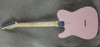
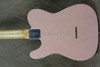
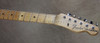
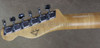
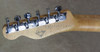
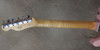
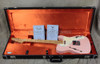
This the Fender Custom Shop Telecaster Masterbuilt by Dale Wilson. Features include Shell Pink Finish, '67 Tele Neck Pickup & Abby Ybarra Wound Neck Pickup. Buy Now!
Fender is a part of American history. The company was started in 1938
by Leo Fender in Fullerton California under the name Fender's Radio
Service. As a qualified electronics technician, Leo Fender had been
asked to repair not only radios, but phonograph players, home audio
amplifiers, public address systems and musical instrument amplifiers.
(At the time, most of these were just variations on a few simple
vacuum-tube circuits.) All designs were based on research developed and
released to the public domain by Western Electric in the '30s, and used
vacuum tubes for amplification. The business also sidelined in carrying
records for sale and the rental of self-designed-and-built PA systems.
Leo became intrigued by design flaws in current musical instrument
amplifiers, and he began custom-building a few amplifiers based on his
own designs or modifications to designs.
By the early 1940s, he
had partnered with another local electronics enthusiast named Clayton
Orr "Doc" Kauffman, and together they formed a company named K & F
Manufacturing Corp. to design, manufacture and sell electric
instruments and amplifiers. Production began in 1945 with Hawaiian lap
steel guitars (incorporating a patented pickup) and amplifiers, which
were sold as sets. By the end of the year, Fender had become convinced
that manufacturing was more profitable than repair, and he decided to
concentrate on that business. Kauffman remained unconvinced, however,
and they had amicably parted ways by early 1946. At that point Leo
renamed the company the Fender Electric Instrument Company. The service
shop remained open until 1951, although Leo Fender did not personally
supervise it after 1947.
Leo Fender soon produced one of the
worlds first solid body electric guitar by autumn 1949,The Fender
Telecaster, colloquially known as the Tele, is typically a dual-pickup,
solid-body electric guitar made by Fender. Its simple yet effective
design and revolutionary sound broke ground and set trends in electric
guitar manufacturing and popular music. Introduced for national
distribution as the Fender Broadcaster in the autumn of 1949, it was the
first guitar of its kind to be produced on a substantial scale. Its
commercial production can be traced as far back as March 1950, when the
single- and dual-pickup Fender Esquire models were first sold. The
Telecaster has been in continuous production in one form or another
since its first incarnation, making it the world's oldest solid-body
electric guitar. Today the Fender Telecaster or the Fender Tele is one
of the most instantly recognizable guitars in the world.
1954
was one of the other most historic years for Fender. That was the year
that the Fender Stratocaster was introduced. Many know it as the Fender
Strat. The Stratocaster was radically sleek, with a contoured body
shape (officially referred to by Fender as the "Comfort Contour Body")
was a marked difference to the flat, slab-like design of the Telecaster.
The body features a unique curve on the upper back and a gradual curve
at the front bottom, where the player's right arm rests. The one-piece
maple neck's uniquely-shaped wide "dogleg"-style headstock again
contrasted to the very narrow Fender Telecaster's headstock shape. The
strings are anchored on a through-body pivot bridge attached with
springs to a 'claw' in the bridge cavity on the back of the guitar. In
its original form, the Stratocaster was offered in a 2-color sunburst
finish on a solid, deeply contoured ash body, a one-piece maple neck
with 21 frets, black dot inlays, and Kluson machine heads, until 1957,
when Fender started making bodies made from solid alder. The '57 Fender
Strat is probably one of the most sought after guitars ever made. There
was also a set of available custom colors that wasn't standardized
until 1960.
In 1959 Fender made some marked changes to their
beloved Fender Stratocaster. From 1959 until summer 1962 the
fingerboard of the Strat was a piece of rosewood milled flat on the
underside and glued to the maple. This has become known as a "slab
fingerboard". The slab fingerboard was approx 4.765 mm at its thichkest
point in the centre of the neck under strings 3 and 4. From mid 1962
until 1979 the rosewood and maple were pre radiused and the fingerboard
became known as curved, round laminate or "veneer", having an even
thickness across the neck unlike the previous slab type.
In 1987
the Fender Custom Shop was opened. It started off in a small 850 sq ft
working space. Fender recruited Texas Guitar Builder Michael Stevens
and John Page, a former Fender R&D engineer. The idea was that
they’d build a few custom instruments for artists and some showpiece
instruments for trade shows. Little did they know what the very near
future held in store for the fledgling operation. That summer they had
over 600 Fender Custom Shop orders. The Fender Custom Shop was
immediately expanded to accommodate the demand. To this day Fender
continues to produce it's Stratocaster, Telecaster, Broadcaster,
Esquire, as well as many models. And Fender is still one of the most
sought after guitars manufacturers in the world. With artists like
Buddy Holly, Eric Clapton, David Gimour, and Stevie Ray Vaughn playing
Fender Guitars you know that they are the real deal. Fender has
definitely left it's mark on the world of music.
|